
For years, we’ve been pretending.
Pretending that new armor skins and softer shadows count as innovation.
Pretending that “better graphics” means “better games.”
Pretending that a sequel with a Roman numeral slapped on the end is “creative progress.”
It’s been over a decade of prettier loading screens—
and nowhere new to go.
🎮 Stuck in the Loop
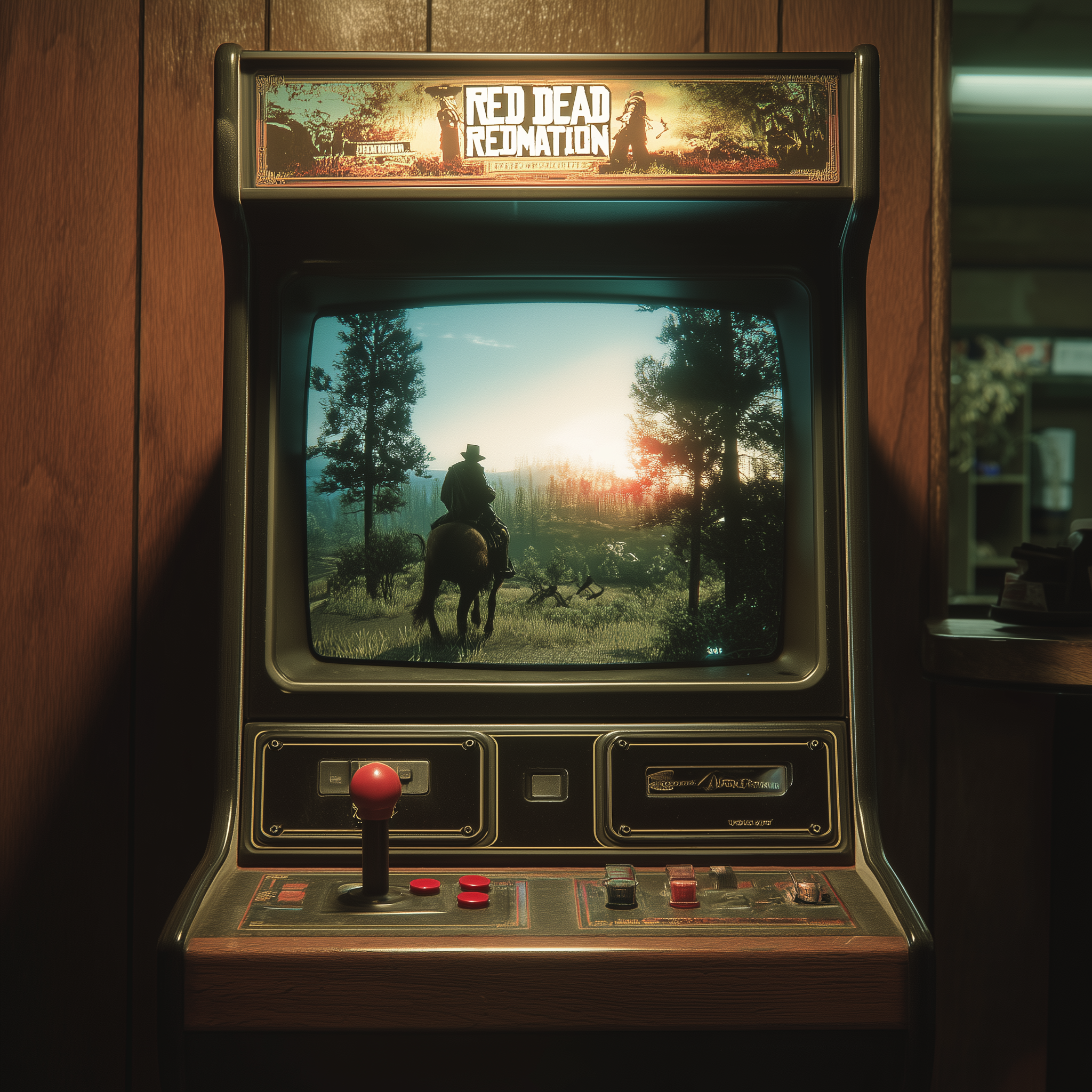
Red Dead Redemption 2 was released in 2018.
It took 8 years to make.
2,000 developers.
Hundreds of millions of dollars.
And even now, it’s held up as the crown jewel.
Why?
Because nothing has come close since.
Because nothing can—under the current system.
Gaming’s “best” is still built on human crunch.
Thousands of people, coding and modeling for years, just to make a tree sway the right way.
It’s poetic. It’s painful.
And it’s not scalable.
Meanwhile, studios grow more cautious.
Investors get more conservative.
Creativity gets crushed under the weight of “what worked last time.”
And the loop tightens.
Then AI Walked In—and Rewrote the Rules
A year ago, most people thought AI could maybe draw a sword.
Now it can build an entire world.
From AI-coded game mechanics to fully generated character backstories, we’ve entered the “Prompt-to-Play” era.
Platforms like Scenario, Inworld, Leonardo AI, and Unity’s Muse are flipping the script.
In months—not years—solo devs are designing mechanics, crafting lore, generating environments, animating dialogue trees, and testing prototypes at 10x speed.
With AI as co-pilot, a tiny team can do what once took Ubisoft-sized armies.
This isn’t about outsourcing.
This is about supercharging imagination.
AI isn’t replacing game designers.
It’s unleashing them.

🎨 The Death of Manual Art?
Let’s get real: most studio artists spend their days drawing rocks.
Or shading 47 variations of bark.
It’s beautiful work—but soul-killing repetition.
Now?
A single designer can generate a full ecosystem in minutes.
Want a Gothic desert with floating temples and neon beetles? Prompt it. Refine it. Drop it in.
More style, less suffering.
Studios like Kepler Interactive and Fable Studio are already experimenting with AI-driven pipelines.
What they’re finding is clear:
Productivity surges.
Morale goes up.
Deadlines shrink.
It’s not just asset creation—it’s asset invention.
AAA Panic Mode Activated
The big boys are nervous.
And they should be.
AI lets indie creators punch way above their weight.
No 2000-person teams. No outsourced QA farms. No bloated middle management.
Just a handful of rebels, a few powerful tools—
and imagination on steroids.
The gatekeepers of gaming?
They’re guarding a door that no longer leads anywhere.
💣 The Real Scandal?
Gaming used to be an art.
Then it became a product.
Now, with AI, it’s becoming a medium again.
But the industry doesn’t know how to respond.
They’ll tell you AI is “dangerous.”
That it “kills jobs.”
That it “lacks the human touch.”
But the truth is simpler:
They’re scared.
Because for the first time, they can’t outspend their way to dominance.
And the next masterpiece?
It won’t come from a boardroom.
It’ll come from a basement, a laptop, and an AI trained to dream.
So What Now?
We can keep waiting.
Hoping the next console generation saves us.
Praying for an original story buried inside another Assassin’s Creed DLC pack.
Or…
We can build the games we wish existed.
With AI on your side, you don’t need permission to start.
You just need vision—and the nerve to ask: what if?